
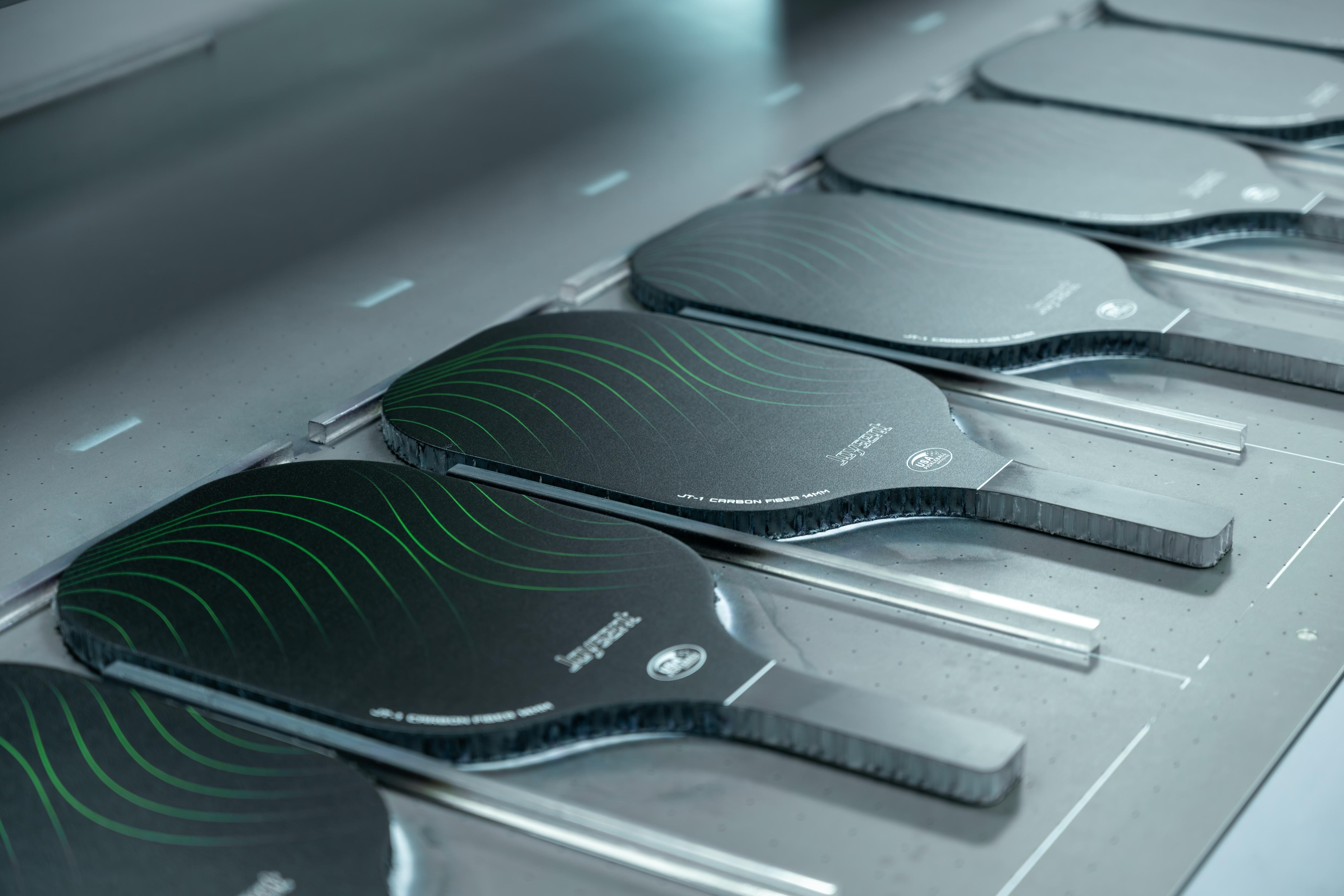
Carbon Surface Grades Explained: T300, T700, and What They Mean
A Clear Guide to 3K, 12K, 18K & 3D 18K for Pickleball Paddles
Summary When shopping for a pickleball paddle, you’ve probably seen terms like T700, 3K, or even 3D 18K thrown around. These carbon fiber grades and weaves aren’t just fancy marketing—they directly affect how your paddle feels, performs, and lasts. In this guide, we break down what these terms mean and how to choose the right surface for your playing style.
🧵 What Does “T300” or “T700” Mean?
“T” stands for “Tow”, a measure of how many filaments are bundled in each carbon fiber thread. The number (e.g. 300, 700) refers to the tensile strength level of the fiber.
➤ T300 Carbon Fiber
-
Grade: Entry-level
-
Performance: Soft feel, moderate strength
-
Common Use: Lower-cost paddles and products
-
Best For: Casual players or beginners looking for comfort
➤ T700 Carbon Fiber
-
Grade: Intermediate to high performance
-
Performance: Stronger and stiffer than T300
-
Common Use: Used in many pro-level paddles
-
Best For: Players wanting more pop, durability, and power
🎯 Fun Fact: Many USAP-approved paddles use T700 due to its excellent balance between stiffness and weight.
🧶 What Do 3K, 12K, and 18K Mean?
These refer to the weave density—the number of carbon filaments per bundle.
-
3K = 3,000 filaments per tow
-
12K = 12,000 filaments per tow
-
18K = 18,000 filaments per tow
The larger the K, the thicker and more rigid the carbon layer becomes.
➤ 3K Carbon Fiber
-
Weave: Tight and fine
-
Feel: More flexible, slightly softer touch
-
Surface: Slicker, less gritty
-
Best For: Control players who prioritize finesse and placement
➤ 12K Carbon Fiber
-
Weave: Thicker bundles, coarser texture
-
Feel: Balanced control and power
-
Surface: Slightly rougher
-
Best For: Versatile players looking for all-around performance
➤ 18K Carbon Fiber
-
Weave: Even larger bundles, fewer intersections
-
Feel: Powerful, stiffer feedback
-
Surface: Naturally textured
-
Best For: Aggressive players who like to drive and finish points
🔍 What Is “3D 18K” Carbon Fiber?
This is a special 3-dimensional woven surface using 18K carbon. Instead of a flat weave, it forms raised patterns or ridges on the surface.
➤ 3D 18K Features
-
Surface: Textured without needing sandpaper or grit spray
-
Spin: Excellent grip on the ball for spin control
-
Durability: Texturing is woven in—not a coating that wears off
-
Feel: Explosive power with precise directional feedback
🚀 Ideal For: Competitive players who use topspin and want long-lasting surface texture without sacrificing power.
🧠 How Do You Choose?
| Player Type | Recommended Surface | Why? |
| Control/Touch Player | 3K or T300 | Softer feel, better finesse |
| Power Baseline Player | T700 + 12K or 18K | More pop and stiffness |
| Spin-Oriented Player | 3D 18K | Superior grip & durability |
| All-Around Player | T700 + 12K | Balanced performance |
🏁 Final Thoughts
Carbon fiber isn’t just a buzzword—it’s a precision material that shapes how you play. Whether you’re just starting out or chasing competitive wins, understanding the differences between T300 vs. T700, 3K vs. 18K, or 2D vs. 3D textures will help you choose the right paddle for your game.
At Joysent, we engineer each paddle with purpose—selecting carbon weaves and core pairings that match real playing needs, not marketing trends.
Previous post
How to Communicate Better in Doubles (Without Arguing!)
Next post
Edge Guard vs. Edgeless Paddles: What’s the Difference?
Related Posts

How to Place Your First Custom Carbon Fiber Pickleball Paddle Order
Step 1: Define Your Target Player Before You Contact AnyoneStep 2: Request a Sample — and Understand Why Low MOQ MattersStep 3: Make Your...
Sep 08 2026

Pickleball Elbow: Causes, Prevention Tips, and the Right Paddle Setup to Protect Your Arm
What Is Pickleball Elbow?Why Pickleball Players Get Elbow Pain More Than They ExpectThe Volume ProblemGrip MechanicsPaddle Stiffness and VibrationPoor TechniquePrevention: What Actually WorksBuild Up...
Sep 07 2026

What Does Your Pickleball Paddle Say About You?
Six player personalities, six custom paddle directions, and one simple way to create a design that feels like it belongs to you. A...
Aug 29 2026

Can You Use a Custom Pickleball Paddle in Tournaments?
Performance, spin, printing methods, and approval rules explained for players who want a paddle that looks personal without treating performance as an afterthought. ...
Aug 29 2026

Why Pickleball Is Booming in Vietnam in 2026
Major tournaments, expanding club participation and a new generation of competitive players are turning Vietnam into one of Asia’s most visible emerging pickleball communities....
Aug 21 2026

Vietnam's Pickleball Breakthrough: Highlights from the 2026 PPA Asia 500 Ho Chi Minh City Open
Vietnam's Pickleball Breakthrough: Highlights from the 2026 PPA Asia 500 Ho Chi Minh City Open From a hometown men's doubles title to historic singles...
Aug 21 2026

High-Performance vs. Recreational Pickleball Paddles: What Actually Changes?
A better paddle is not simply more powerful. Here is what players actually gain when they move from recreational equipment to a performance-focused design....
Aug 15 2026

Singles vs. Doubles Pickleball Paddles: Do You Need a Different Paddle?
Singles rewards reach, leverage, and court coverage. Doubles puts a premium on quick hands, stability, and control. Here is how to choose without buying...
Aug 15 2026